
Acute myocardial infarction is one of the most heavily tested topics on USMLE Step 2 CK. The exam wants you to know the next best step, which drugs to avoid, and how to recognize post-MI complications. Try these three questions, then open each explanation.
Question 1: Inferior STEMI with low blood pressure and clear lungs
A 62-year-old man comes to the emergency department with crushing chest pain that began 1 hour ago. His blood pressure is 84/50 mm Hg and pulse is 58/min. Jugular venous pressure is elevated, and the lungs are clear to auscultation. ECG shows ST-segment elevation in leads II, III and aVF, and right-sided leads show ST elevation in V4R. Aspirin has been given and the cardiac catheterization team has been called. Which of the following is the most appropriate next step to treat his hypotension?
A. Sublingual nitroglycerin
B. Intravenous furosemide
C. Intravenous normal saline bolus
D. Intravenous metoprolol
E. Intravenous morphine
Question 2: Anterior STEMI far from a catheterization lab
A 58-year-old man has had substernal chest pain for 45 minutes. ECG shows ST-segment elevation in leads V1 through V4. He is at a small rural hospital, and the nearest hospital capable of percutaneous coronary intervention (PCI) is a 3-hour transfer away. He has no history of bleeding, stroke or recent surgery. Blood pressure is 142/88 mm Hg. Aspirin has been given. Which of the following is the most appropriate next step?
A. Transfer for primary PCI without fibrinolysis
B. Heparin infusion and observation
C. CT angiography of the chest
D. Exercise stress testing
E. Fibrinolytic therapy, then transfer to a PCI-capable hospital
Question 3: New murmur and pulmonary edema 4 days after an MI
A 66-year-old man was admitted 4 days ago with an inferior wall myocardial infarction. He suddenly develops severe shortness of breath. Blood pressure is 86/52 mm Hg. There are crackles over both lung fields and a new holosystolic murmur heard best at the apex, radiating to the axilla. Which of the following is the most likely cause?
A. Ventricular septal rupture
B. Papillary muscle rupture
C. Left ventricular free wall rupture
D. Dressler syndrome
E. Left ventricular aneurysm
Key takeaways
- Inferior STEMI + hypotension + clear lungs = RV infarct: give fluids, avoid nitrates.
- STEMI: primary PCI if possible within ~120 minutes; otherwise fibrinolysis within 30 minutes.
- New apical holosystolic murmur 2–7 days after MI = papillary muscle rupture.
More USMLE practice questions
- All USMLE Step 2 CK questions
- Newborn care, stroke airway and myelomeningocele
- Psychiatry: panic disorder and agoraphobia
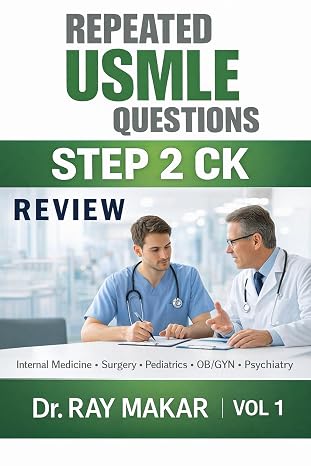
Want 100+ more clinical questions like these?
Get Repeated USMLE Questions Step 2 CK Review Vol 1 by Dr. Ray Makar
As an Amazon Associate, I earn from qualifying purchases.
Written and reviewed by Dr. Ray Makar, MD, dermatologist with 20 years of clinical practice. Last reviewed: October 2026. For exam preparation only, not medical advice.