
Step 2 CK loves “next best step” questions about emergencies. The key is to spot the case that cannot wait: torsion goes straight to surgery, mesenteric ischemia needs CT angiography, and an unstable patient needs resuscitation first. Read the table, then try these 10 clinical cases.
Surgical emergencies at a glance
| Emergency | Key clue | Next step |
|---|---|---|
| Testicular torsion | Sudden pain, high-riding testis, absent cremasteric reflex | Surgery now (do not wait for ultrasound) |
| Ovarian torsion | Sudden one-sided pelvic pain, enlarged ovary, low blood flow | Emergency laparoscopy |
| Acute mesenteric ischemia | Pain out of proportion to exam, atrial fibrillation, high lactate | CT angiography |
| Ischemic colitis | Pain then bloody stool after aortic surgery or low blood flow | Supportive care; CT and colonoscopy |
| Severe acute pancreatitis | Shock or low oxygen despite fluids | ICU care |
| Variceal bleeding | Alcohol use, vomiting blood, shock | Fluids, IV octreotide, antibiotics, then banding |
| Malignant hyperthermia | Rigidity, fever, high CO2 after anesthesia | Stop the trigger, give dantrolene |
Question 1: Sudden scrotal pain
A 29-year-old man has sudden, severe scrotal pain and nausea. The testis is high-riding with a horizontal lie, and the cremasteric reflex is absent. What is the best next step?
A. Oral antibiotics
B. Scrotal ultrasound before any intervention
C. Supportive care and discharge
D. Immediate surgical exploration
Question 2: One-sided pelvic pain with an enlarged ovary
A 24-year-old woman has sudden, severe one-sided lower abdominal pain and nausea. Ultrasound shows an enlarged ovary with decreased blood flow. What is the best next step?
A. Broad-spectrum antibiotics
B. Emergency laparoscopy
C. Repeat ultrasound in 24 hours
D. Start oral contraceptives
Question 3: PID that gets worse
A 31-year-old woman has pelvic pain and fever for 2 days. She has purulent cervical discharge and cervical motion tenderness. Her pregnancy test is negative. She is diagnosed with pelvic inflammatory disease (PID) and started on antibiotics. Two days later, she returns with worse pain and a tender adnexal mass. What is the most likely diagnosis?
A. Appendicitis
B. Ectopic pregnancy
C. Ovarian torsion
D. Tubo-ovarian abscess
Question 4: Pain out of proportion to the exam
A 72-year-old woman with atrial fibrillation has sudden, severe abdominal pain. Her abdomen is soft with little tenderness. Lactate is high. What is the best next diagnostic step?
A. Abdominal ultrasound
B. Colonoscopy
C. CT angiography
D. Plain abdominal X-ray
Question 5: Bloody stool after aneurysm repair
A 76-year-old woman has abdominal pain followed by bright red blood per rectum. She recently had repair of an abdominal aortic aneurysm. What is the most likely diagnosis?
A. Diverticular bleeding
B. Infectious colitis
C. Ischemic colitis
D. Ulcerative colitis
Question 6: Gallstone pancreatitis that is settling down
A 61-year-old man has sudden, severe abdominal pain after a large meal. The pain goes through to his back. Lipase is very high. Ultrasound shows gallstones without a dilated bile duct. He improves with fluids and pain control. What is the most appropriate next step?
A. Cholecystectomy during the same hospital stay
B. ERCP
C. Immediate laparotomy
D. Start antibiotics
Question 7: Pancreatitis with shock and low oxygen
A 64-year-old man has severe epigastric pain going through to his back. He has fever and a fast heart rate. Lipase is 1,800 U/L and ultrasound shows gallstones. Despite IV fluids and pain control, over the next 12 hours he becomes hypotensive and his oxygen level falls. What is the best next step?
A. Broad-spectrum antibiotics now
B. ERCP now
C. Start oral feeding
D. Transfer to the ICU for aggressive supportive care
Question 8: Fever and free air after colon surgery
A 57-year-old man has a colon resection. On day 3 after surgery he develops fever, a fast heart rate and abdominal pain. His blood pressure is 88/50 mm Hg. The abdomen is distended and tender. CT shows free air and a fluid collection. What is the best next step?
A. Broad-spectrum antibiotics only
B. Percutaneous drainage
C. Return to the operating room
D. Supportive care and observation
Question 9: Fever and rigidity after anesthesia
A 71-year-old man develops high fever, muscle rigidity, a fast heart rate and confusion while recovering from general anesthesia for hip surgery. Labs show very high creatine kinase, high potassium and acidosis. What is the most likely diagnosis?
A. Malignant hyperthermia
B. Neuroleptic malignant syndrome
C. Serotonin syndrome
D. Thyroid storm
Question 10: Vomiting blood with a history of alcohol use
A 60-year-old man with long-term alcohol use is vomiting large amounts of bright red blood. He is hypotensive and tachycardic. Bleeding esophageal varices are suspected. What is the best initial management?
A. Start a β-blocker
B. Endoscopic band ligation before any other treatment
C. IV fluids, blood as needed and IV octreotide
D. IV proton pump inhibitor alone
Key takeaways
- Testicular torsion: go to surgery without waiting for ultrasound; best within 6 hours.
- Ovarian torsion: emergency laparoscopy.
- PID that gets worse on antibiotics with a mass: tubo-ovarian abscess.
- Pain out of proportion plus atrial fibrillation: mesenteric ischemia, so order CT angiography.
- Bloody diarrhea after AAA repair: ischemic colitis (splenic flexure, rectosigmoid).
- Gallstone pancreatitis: cholecystectomy in the same admission. Severe pancreatitis with organ failure: ICU.
- Fever and shock 3 to 7 days after bowel surgery: anastomotic leak, back to the operating room.
- Malignant hyperthermia: dantrolene. Variceal bleeding: resuscitation, octreotide, antibiotics, then banding.
More USMLE practice questions
- All USMLE Step 2 CK questions
- Pediatric surgery: pyloric stenosis, intussusception and volvulus
- OB/GYN: placenta previa, eclampsia and magnesium toxicity
- Pulmonology: PE, asthma and tension pneumothorax
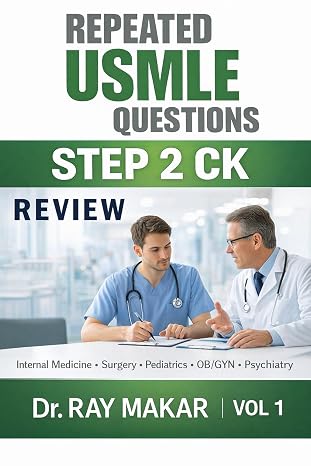
Want 100+ more clinical questions like these?
Get Repeated USMLE Questions Step 2 CK Review Vol 1 by Dr. Ray Makar
As an Amazon Associate, I earn from qualifying purchases.
Written and reviewed by Dr. Ray Makar, MD, dermatologist with 20 years of clinical practice. Last reviewed: November 2026. For exam preparation only, not medical advice.
FREE USMLE PDFs
Get 80 free practice questions
Four free sampler PDFs by Dr. Ray Makar: Step 1 (Pathology & Pharmacology) and Step 2 CK (Medicine, Surgery & Pediatrics), in both Review style and USMLE style, with answers and explanations. Also useful for NEET-PG, INI-CET and FMGE.
Download the free PDFs See the full books →