
Third-trimester emergencies are high-yield on USMLE Step 2 CK. You need to know what to do first, what not to do, and how to recognize medication toxicity. Try these three questions, then open the explanations.
Question 1: Painless bright red bleeding at 34 weeks
A 32-year-old woman, gravida 3, para 2, at 34 weeks’ gestation comes to the labor and delivery unit because of painless, bright red vaginal bleeding that started 1 hour ago. She has had no prenatal care. Her blood pressure is 118/72 mm Hg and pulse is 92/min. The uterus is soft and nontender. Fetal heart rate tracing is reassuring. Which of the following is the most appropriate next step?
A. Digital cervical examination
B. Transabdominal ultrasonography
C. Immediate cesarean delivery
D. Oxytocin infusion
E. Amniotomy
Question 2: Severe hypertension, headache and a seizure at 36 weeks
A 28-year-old primigravid woman at 36 weeks’ gestation has a severe headache. Her blood pressure is 168/112 mm Hg on two readings 15 minutes apart, and urinalysis shows 3+ protein. While being evaluated, she has a generalized tonic-clonic seizure. Which of the following is the most appropriate drug to prevent further seizures?
A. Lorazepam
B. Phenytoin
C. Labetalol
D. Magnesium sulfate
E. Levetiracetam
Question 3: Absent reflexes and slow breathing during treatment
A 30-year-old woman at 32 weeks’ gestation with preeclampsia with severe features is receiving an intravenous magnesium sulfate infusion. Six hours later she is drowsy. Her respiratory rate is 8/min, and patellar reflexes are absent. Urine output has decreased over the past 4 hours. Which of the following is the most appropriate next step?
A. Stop the magnesium infusion and give intravenous calcium gluconate
B. Increase the magnesium infusion rate
C. Give intravenous naloxone
D. Give intravenous labetalol
E. Give intravenous furosemide only
Key takeaways
- Painless third-trimester bleeding = placenta previa: ultrasound first, never a digital exam first.
- Eclampsia: magnesium sulfate prevents seizures; delivery is the definitive treatment.
- Magnesium toxicity: lost reflexes, then respiratory depression; stop the infusion and give calcium gluconate.
More USMLE practice questions
- All USMLE Step 2 CK questions
- Newborn care, stroke airway and myelomeningocele
- Psychiatry: panic disorder and agoraphobia
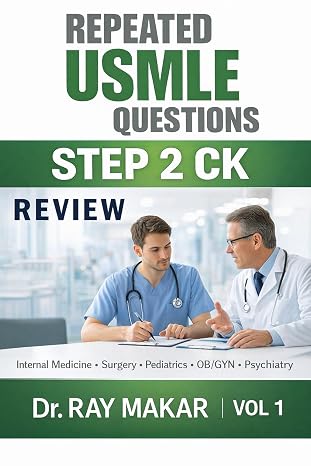
Want 100+ more clinical questions like these?
Get Repeated USMLE Questions Step 2 CK Review Vol 1 by Dr. Ray Makar
As an Amazon Associate, I earn from qualifying purchases.
Written and reviewed by Dr. Ray Makar, MD, dermatologist with 20 years of clinical practice. Last reviewed: October 2026. For exam preparation only, not medical advice.
FREE USMLE PDFs
Get 80 free practice questions
Four free sampler PDFs by Dr. Ray Makar: Step 1 (Pathology & Pharmacology) and Step 2 CK (Medicine, Surgery & Pediatrics), in both Review style and USMLE style, with answers and explanations. Also useful for NEET-PG, INI-CET and FMGE.
Download the free PDFs See the full books →