
Vomiting in an infant is a common USMLE Step 2 CK scenario. The age, whether the vomit is bilious, and the stool findings point to the diagnosis, and the exam asks for the next best step. Try these three questions.
Question 1: A 4-week-old with forceful vomiting after every feed
A 4-week-old firstborn boy has had forceful, nonbilious vomiting after every feeding for 5 days. He seems hungry right after vomiting. He has dry mucous membranes. A small, firm, mobile mass is felt in the epigastrium. Ultrasonography shows a thickened, elongated pylorus. Serum chloride is 88 mEq/L, potassium 3.1 mEq/L and bicarbonate 34 mEq/L. Which of the following is the most appropriate next step?
A. Immediate pyloromyotomy
B. Upper GI contrast study
C. Intravenous fluid resuscitation and correction of electrolytes
D. Start a proton pump inhibitor and thicken feeds
E. Air enema
Question 2: Episodes of crying with legs drawn up, then a bloody stool
An 18-month-old boy has had episodes of severe, crampy abdominal pain for 12 hours. During each episode he screams and draws his knees up to his chest; between episodes he is drowsy. He has vomited twice and just passed a stool that looks like red currant jelly. A sausage-shaped mass is felt in the right upper abdomen. He is hemodynamically stable with no signs of peritonitis. Ultrasonography shows a “target sign.” Which of the following is the most appropriate treatment?
A. Air or contrast enema
B. Exploratory laparotomy
C. Intravenous antibiotics and observation
D. Upper GI contrast study
E. Colonoscopy
Question 3: Sudden green vomiting in a 10-day-old
A 10-day-old girl, previously feeding well, suddenly develops repeated bright green vomiting. She is irritable, and her abdomen is mildly distended. Vital signs are normal. Abdominal x-ray shows a few dilated loops of bowel without free air. Which of the following is the most appropriate next step?
A. Abdominal ultrasonography for pyloric thickness
B. Observation and repeat x-ray in 24 hours
C. Barium enema
D. Switch to a soy-based formula
E. Emergency upper GI contrast study
Key takeaways
- Pyloric stenosis: nonbilious projectile vomiting, hypochloremic hypokalemic metabolic alkalosis; fix fluids first, then pyloromyotomy.
- Intussusception: currant jelly stool and target sign; air or contrast enema if stable.
- Bilious vomiting in a newborn = malrotation with volvulus until proven otherwise; emergency upper GI series.
More USMLE practice questions
- All USMLE Step 2 CK questions
- Newborn care, stroke airway and myelomeningocele
- Slipped capital femoral epiphysis and childhood hip disorders
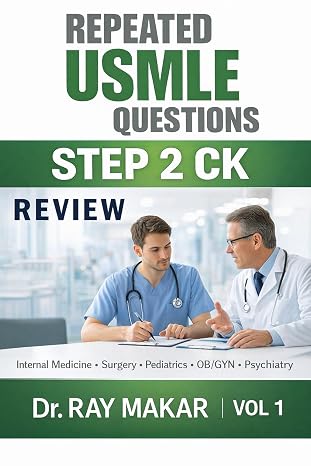
Want 100+ more clinical questions like these?
Get Repeated USMLE Questions Step 2 CK Review Vol 1 by Dr. Ray Makar
As an Amazon Associate, I earn from qualifying purchases.
Written and reviewed by Dr. Ray Makar, MD, dermatologist with 20 years of clinical practice. Last reviewed: October 2026. For exam preparation only, not medical advice.
FREE USMLE PDFs
Get 80 free practice questions
Four free sampler PDFs by Dr. Ray Makar: Step 1 (Pathology & Pharmacology) and Step 2 CK (Medicine, Surgery & Pediatrics), in both Review style and USMLE style, with answers and explanations. Also useful for NEET-PG, INI-CET and FMGE.
Download the free PDFs See the full books →